
Vulnerability and Discipleship
Beyond simply being a non-anxious presence

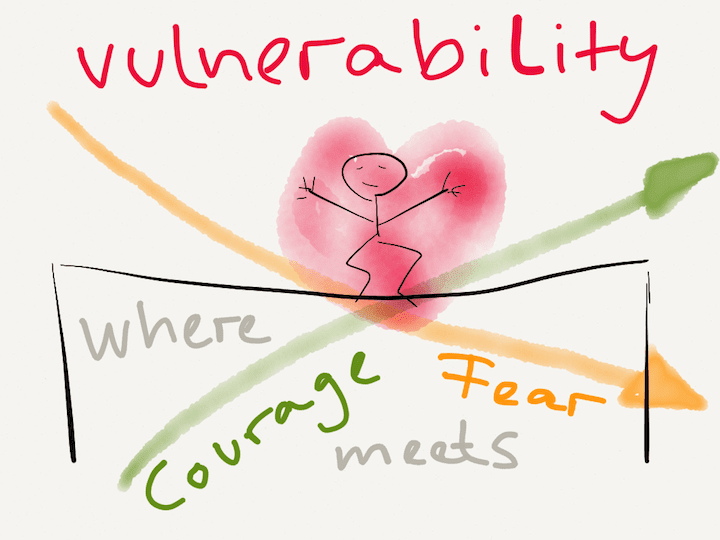
Mark Sayers posits that, because of the anxiety plaguing so many Christians today, the church leader’s bottom line role these days is to be a non-anxious presence.[1] This seems very limiting to me. Perhaps it’s just because I’m older and can remember sitting in a Billy Graham crusade and hearing an uncompromising Gospel message. I even recall reading Jonathan Edward’s sermon “Sinners in the Hands of an Angry God” in high school English, of all places. We’ve come a long way. As we take care to be a non-anxious presence for the emerging generations, I must ask, where is the victorious church? Can the church still impact the world if anxiety and a lack of trust are as rife in the church as they are in the world?
Further, what happens when church leadership are unhealed of the hurt and abuse they have experienced? Can the church long survive the resultant strongholds that leaders will create to self-protect themselves? Almost twenty-five years ago, Jim Bakker wrote:
I am convinced that many Christian people are forgiven of their sins, but they have never been healed of that’s sin’s impact in their lives. Why? Because they have never gotten close enough to a group of fellow believers with whom they could be absolutely honest—honest enough to confess their sins to their brothers or sisters in the Lord. They are clean, but they are not whole; forgiven, but not healed.[2]
This has never been more true than today.
Gen Z will one day be in charge and responsible as leaders for the health of those they lead. I understand God can take care of his Church, and has for 2,000 years. But I also recognize that in its history the Church has vacillated between being a change agent and a benign presence (or worse). Some of that depends on generational personalities, but it also depends on the upbringing of the generations.
My church is just beginning to experience these growing pains, and I suppose that’s one reason the subject of vulnerability has become so important to me. We are at a turning point in the life of our church, and it mostly centers on the leadership. I think a strength of my church is its intergenerational nature: Boomers, Millennials, and Gen Z are all represented in the leadership team. There is a recognition that if we want a healthy body, first the leadership needs to be healthy. So, this past summer, the leadership went through Peter and Geri Scazzero’s Emotionally Healthy Relationships.[3] This is a positive first step, but I feel there is a long road ahead of us.
The core concern in my church is that everyone is involved in an ongoing, healthy discipleship relationship. This sounds straight-forward, but in reality, there is much that makes up these healthy relationships. First, individuals need to want to be in such a relationship. Mostly, life is just simpler on our own, without having to check in with someone and be accountable to them. But second, the discipleship my church has in mind goes beyond mere accountability. After all, one problem in the 1990s was that so many well-meaning programs were nothing more than accountability, without a sense of the growth needed for faith to be sustainable over a lifetime. The kind of discipleship my church has in mind requires a change in culture, which is never easy. “Creating a culture where vulnerability can be fostered takes time. Churches that invest heavily in cultivating a certain pristine image (through social media, or heavily airbrushed leadership models) will likely find it harder to create a space with permission for people to make mistakes.”[4]
In his book Organic Community, [5] Joseph Myers distinguishes between accountability and what he calls edit-ability. He considers accountability to be part of a master plan approach to life, a top-down monitoring system where the overriding concern is preventing failure. In contrast, edit-ability is more organic and more likely to promote community. Myers writes:
An editor’s function differs greatly from that of an accountant. While an accountant’s training, job, and passion are rooted in looking for errors and covering all bases, an editor’s training, job, and passion are to help an author toward richer communication—a rich, full voice that is free of encumbrances. Accountants keep records. Editors wipe away errors while keeping the voice of the author.[6]
In the organic order, relationships are not unidirectional, but bidirectional and even multi-directional. Authority is not top down or vertical, but horizontal, shared among the many. In this context, the disciple is not merely a vessel to be poured into; the discipler can just as easily learn from the disciple (sometimes referred to as reverse mentoring).
So, what is it we’re supposed to be discipling? In my experience, we disciple others from our gifting, or at least we should. This keeps us within the limit of our anointing (Romans 12:3). But to do that, we have to “know thyself,” one of the Delphic maxims that is older than the Church. We have to be familiar with our giftings beyond simply taking a test online. We have to dig into the gifts lists of the New Testament (Romans 12, 1 Corinthians 12, Ephesians 4), believing the Apostle Paul did not place them there as a tease. Rather, we need to be convinced of the importance of engaging with these giftings today, including practicing them. Thus, teachers disciple teachers, pastors disciple pastors, and so forth.
Unfortunately, this is not all that gets discipled in a fallen world. There are also what I call anti-giftings, those things that work to the detriment of ourselves and others. I witnessed as a missionary that control disciples control, and manipulation disciples manipulation, and this includes church leadership. Though disciples may initially be attracted to someone in authority because of their leadership skills, the discipler too often replicates something potentially harmful. Disciplers can pass on unhealed wounds, such as sexual, physical, or emotional abuse. This is not unlike the way drug addiction or alcoholism passes from parent to child, becoming a generational curse. This is not the generational inheritance we want for the church.
[1] Sayers, A Non-Anxious Presence.
[2] Bakker, Refuge, p. 140.
[3] Scazzero & Scazzero, Emotionally Healthy Relationships.
[4] Cockayne, et al., Dawn of Sunday, “Principles of a Trauma-Safe Church.”
[5] Myers, Organic Community.
[6] Ibid, p. 139.